Tyrion Lannister
A Clash of KingsTyrion Lannister, called the Imp, is presented as a man whom the world reads through his body before it recognizes his intelligence. His pushed-in face, bulging brow, mismatched eyes, dwarf stature, beard, and injured arm make him an object of hostile attention, yet the same figure repeatedly converts humiliation, observation, and danger into political advantage. His decisive significance lies in the contrast between apparent physical inadequacy and practical authority: he is underestimated by enemies and relatives alike, but his judgment becomes one of the chief instruments by which royal power survives crisis.
Identity and Introduction
Tyrion enters the Red Keep not in the splendid isolation expected of a royal counselor but amid a battered column of Lannister soldiers, freeriders, sellswords, and scarred savages. The gate has been closed for days because of unrest in the city, and his arrival therefore announces both military reinforcement and a breach in the castle’s defensive routine. He rides a tall red horse in a high saddle that cradles him front and back, wears a shadowskin cloak striped with white, holds the reins in his left hand, and keeps his right arm in a white silk sling. His beard has grown into a coarse yellow-and-black tangle that partly covers his damaged face, but it does not erase the grotesque impression remembered by Sansa Stark.
The scene also complicates the expectation that Tyrion’s appearance makes him powerless. Tommen Baratheon gallops toward him with delight, and a huge warrior lifts the boy from his pony and sets him beside his uncle. Tyrion claps Tommen on the backplate, then picks up Myrcella Baratheon and spins her before kissing her brow. Sansa Stark is startled to see Tyrion and Tommen standing at the same height, while the children’s uninhibited affection contrasts with the contemptuous gaze directed at Tyrion by adults. His family position, not his stature, gives him access to the center of power, and his conduct with the royal children shows that he can command emotional allegiance where formal authority is brittle.
Political Intelligence and Family Leverage
Tyrion’s first political victory is deliberately small but psychologically important. At the door of the king’s council chamber, Ser Mandon Moore permits Tyrion to enter while refusing admission to the men who accompany him. Tyrion shoulders through the door and privately recognizes that he has passed his first test. He does not answer exclusion with open outrage; instead, he adopts casual confidence, pauses to admire the Valyrian sphinxes, and remarks on Joffrey Baratheon’s courtesies. His performance turns a humiliating examination into a display of self-possession.
His encounter with Cersei Lannister reveals a more substantial form of power. Cersei receives him with disbelief and distaste, studies him without affection, and treats his presence as an intrusion. Tyrion, however, understands that her fear is connected to the safety of her son and to the threatened stability of the throne. He assures her that Joffrey is as safe with him as with her, while also arguing that a threatened boy will be more inclined to listen. The calculation is not merely paternal or sentimental: Tyrion intends to influence Joffrey by making himself a source of security rather than another visible threat.
Tyrion then takes Cersei’s hand and reminds her that he is her brother, that she needs him whether she admits it or not, and that Joffrey needs him if the boy is to retain the Iron Throne. Cersei is shocked by the touch, but the gesture carries political meaning. Tyrion places kinship, usefulness, and royal survival in one argument, forcing his sister to confront the practical value of the brother she despises. His wit is therefore not only verbal ornament. It is a method of identifying dependence and making that dependence impossible to ignore.
Administration and the Defense of the City
As Hand of the King, Tyrion turns technical preparation into a political weapon. In his private audience chamber, dressed in black velvet covered with golden lion heads and a gold chain formed from clasping hands, he receives smiths, armorers, and ironmongers whom Bronn has assembled. He presents them with three immense steel links twisted together and orders a thousand more made at the castle forge. When one smith calls it a mighty chain, Tyrion answers that it is mighty but short and asks for a name. The object becomes the beginning of the Chain boom across the Blackwater, a defense whose force depends on disciplined craft rather than heroic spectacle.
The contrast between Tyrion’s body and his instruments of war is central to his portrayal. The chain is immense, heavy, and designed to control the movement of ships; Tyrion is repeatedly described as small, awkward, or physically damaged. Yet he is the person who imagines the scale of the device and organizes the labor required to reproduce it. His authority operates through planning, manufacture, and coordination, demonstrating that the defense of a city depends as much on foresight as on the strength of the men who will later stand at the walls.
Tyrion also receives unwelcome truth about the political and social condition of the capital. Jacelyn Bywater tells him that the city was held for the day but cannot be promised for the next. Thieves and murderers are abroad, the bloody flux is spreading through the stews along Pisswater Bend, food cannot be bought even with copper or silver, and treason is now openly discussed in guildhalls and markets rather than merely muttered in the gutters. Tyrion asks whether more men are needed, but Bywater explains that half the existing Watch cannot be trusted: the enlarged force contains brutes, drunkards, cowards, and traitors, many of them half-trained and loyal chiefly to their own skins. Tyrion’s strategic problem is consequently larger than an assault on the walls. He must defend a city whose institutions, food supply, public confidence, and armed personnel are all failing at once.
The queen’s response to civilians seeking refuge makes the political stakes sharper. When Osfryd Kettleblack reports that rich merchants are gathering in the square and asking to enter the castle, Cersei orders them sent home and authorizes the crossbowmen to kill several if they refuse. She forbids sorties and refuses to open the gates for any reason. Tyrion’s position is thus defined against a defensive policy rooted in fear and confinement. He recognizes that walls alone cannot solve a crisis in which the ruling family distrusts both the populace outside and the soldiers inside.
The Sortie and the Measure of Courage
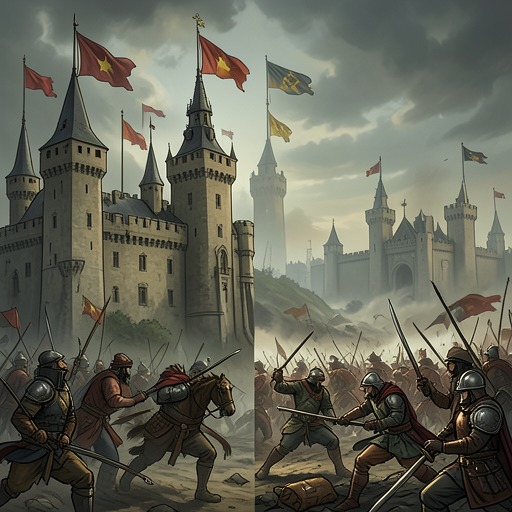
During the assault on the city, Tyrion sees that Sandor Clegane is exhausted by his wound and the fire. The men around them are shaken by the Hound’s fear, and Tyrion judges that Ser Mandon Moore is dangerous but not a leader whom others would follow. The immediate military problem is therefore a vacuum of command. Tyrion understands that retreat may be safer for one man but catastrophic for the defense as a whole.
He concludes that madness is preferable to defeat and declares that he will lead the sortie. The decision reverses every expectation attached to his body and rank. Sandor Clegane laughs at the idea that Tyrion will lead, while the surrounding men show the same disbelief, but Tyrion does not seek their admiration. He orders Ser Mandon to bear the king’s banner, tells Podrick Payne to bring his helm, mounts again with assistance, and shouts for the formation to assemble. His authority becomes visible not because the men suddenly cease to doubt him, but because he acts while doubt remains.
This moment also completes the pattern established by the chain. Tyrion’s strength is not the fantasy that he is secretly physically imposing; the evidence insists on his vulnerability, his wound, and the difficulty of mounting. His courage is instead practical and chosen. He recognizes death and shame as the consequence of defeat, accepts the danger of personal command, and uses symbols, orders, and example to make action possible for others. The small man who was mocked at the gate becomes the figure willing to pass through it toward the enemy.
Narrative Role and Thematic Significance
Across these episodes, Tyrion is surrounded by competing forms of knowledge. Bran Stark hears the direwolves’ mourning without understanding whom they mourn; Daenerys Targaryen insists that her dragons belong to her and will not surrender them while she lives; Arya Stark learns fear through the daily deaths inflicted by Ser Gregor Clegane; Theon Greyjoy notices the absence of the direwolves’ howling only after becoming accustomed to it; and Jon Snow dreams of five scattered wolves where there should be six. These parallel scenes show animals, bodies, and silences carrying knowledge that political rulers often miss. Tyrion’s own method is different but related: he listens for weakness, distrust, institutional failure, and changes in behavior, then turns those observations into action.
His disability is not treated solely as a sentimental emblem or a problem awaiting correction. Other characters do reduce him to ugliness or stature, and the narrative repeatedly exposes the cruelty of that gaze, but Tyrion’s physical difference also shapes the tactics by which he moves through society. He performs confidence when challenged, uses wit to redirect contempt, builds authority through objects and procedures, and accepts assistance without surrendering command. The high saddle, the sling, the short cloak cut to his height, and the great chain all make bodily scale materially visible; together they show a man negotiating environments designed around other bodies rather than simply overcoming difference through miraculous transformation.
Tyrion’s role is consequently neither that of a conventional warrior nor that of a powerless outsider. He is an administrative strategist, a family negotiator, an observer of social collapse, and, when necessary, a commander who risks himself. The affectionate welcome from Tommen and Myrcella, Cersei’s reluctant recognition that he is useful, the smiths’ obedience, Bywater’s grim report, and the soldiers’ disbelief before the sortie trace the same arc: Tyrion must continually convert presence into authority. His deepest victory is not that others stop seeing him as strange, but that their contempt repeatedly fails to prevent him from shaping events.